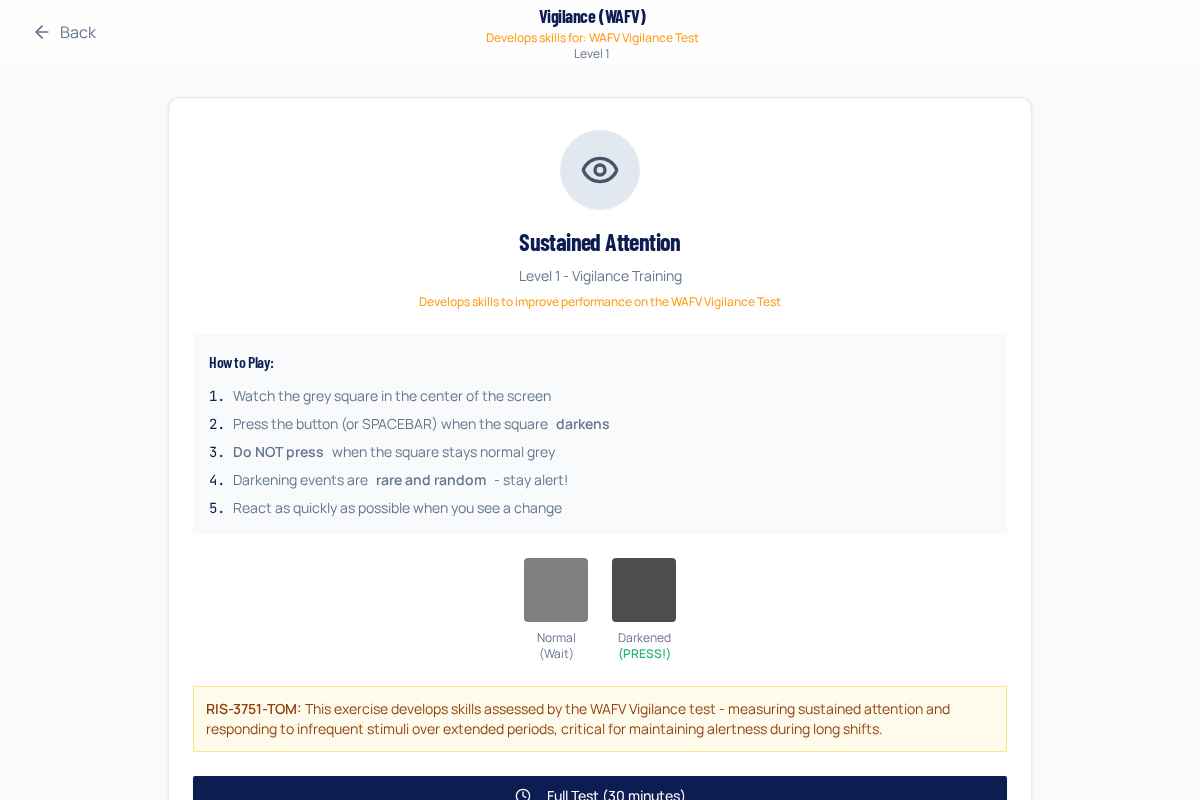
This practice develops vigilance: the ability to stay alert and respond correctly to infrequent stimuli over an extended period. The skill is quiet alertness, not constant activity.
Why This Matters for Train Drivers
- Train driving includes long periods of low stimulation.
- Rare events must still be detected accurately.
- False responses can be as problematic as missed responses.
- The assessment rewards sustained control rather than impulsive reactions.
Real-World Examples
- •Detecting an unusual trackside condition after routine running.
- •Remaining alert after repeated normal signal aspects.
- •Responding only when the correct cue is present.
- •Maintaining concentration during night or monotonous sections.
RIS-3751-TOM Standard
RIS-3751-TOM lists vigilance as the ability to attend and respond to infrequent stimuli over extended periods, assessed using WAFV.
Pro Tip to Improve
Train calm alertness. Most of the task is doing nothing correctly, then responding cleanly when the right cue appears.
This practice exercise develops the cognitive abilities assessed in official train driver selection, specifically:
Vigilance monitoring assessments (e.g., WAFV-style tests)
Based on RIS-3751-TOM requirements. Learn more about official assessments →
Level 1
Premium
Level 2
Premium
Level 3
Premium
Level 4
Premium
Level 5
Premium
J.O.
M.T.J.L.
T.W.
J.B.
J.D.