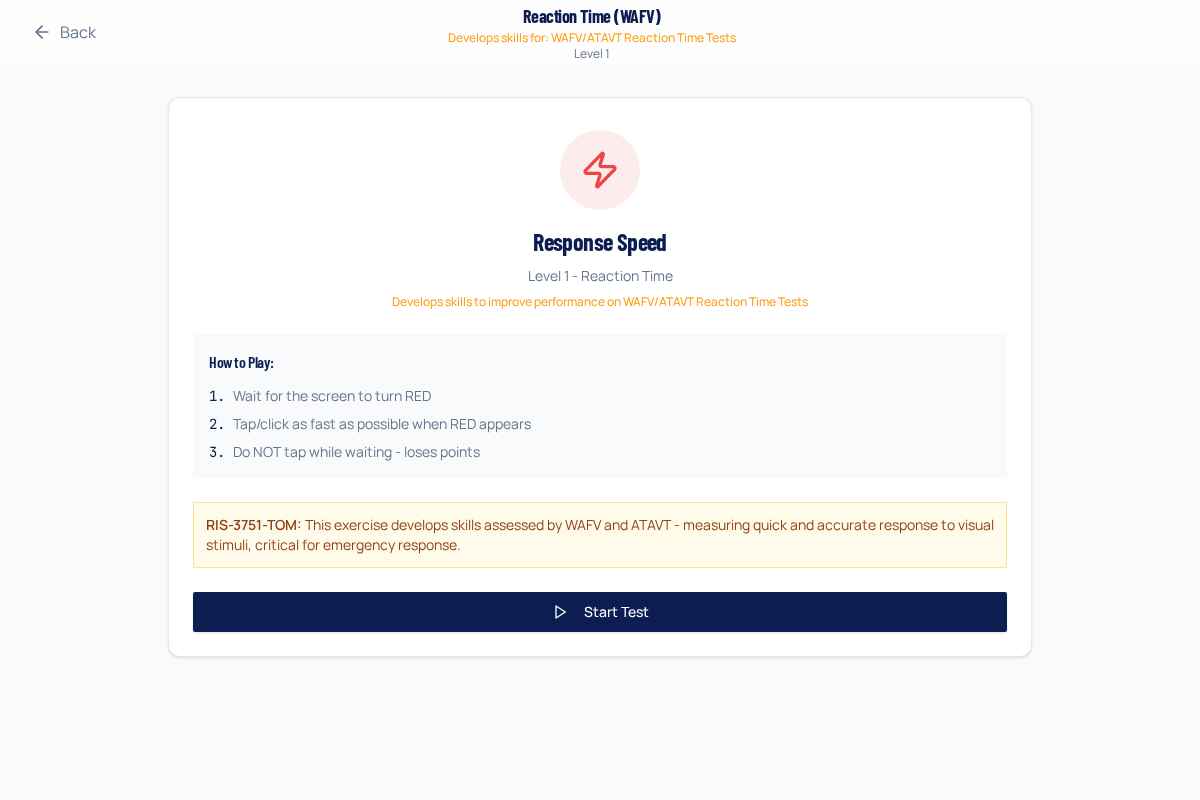
This practice develops response speed and response quality. In train driver assessment, reaction time is not just about being fast; it is about responding quickly enough while staying accurate and controlled.
Why This Matters for Train Drivers
- Drivers must respond to visual and acoustic stimuli appropriately.
- An incorrect fast response can be worse than a slightly slower correct response.
- Response inhibition is part of safe decision-making.
- Consistency matters across the whole assessment, not only the first few items.
Real-World Examples
- •Responding correctly to an AWS or warning cue.
- •Reacting to a changed indication without panic.
- •Avoiding an unnecessary action when the cue is not present.
- •Maintaining performance after a missed or late response.
RIS-3751-TOM Standard
RIS-3751-TOM defines reaction time as a quick and adequate response to simple and complex visual and acoustic stimuli, with associated quality of performance, assessed through WAFV and ATAVT.
Pro Tip to Improve
Practise clean responses, not frantic ones. The target is reliable speed with accuracy, not raw reflex performance.
This practice exercise develops the cognitive abilities assessed in official train driver selection, specifically:
Reaction time assessments used in safety-critical role selection
Based on RIS-3751-TOM requirements. Learn more about official assessments →
Level 1
Premium
Level 2
Premium
Level 3
Premium
Level 4
Premium
Level 5
Premium
J.M.
P.S.
M.K.
H.L.
A.R.