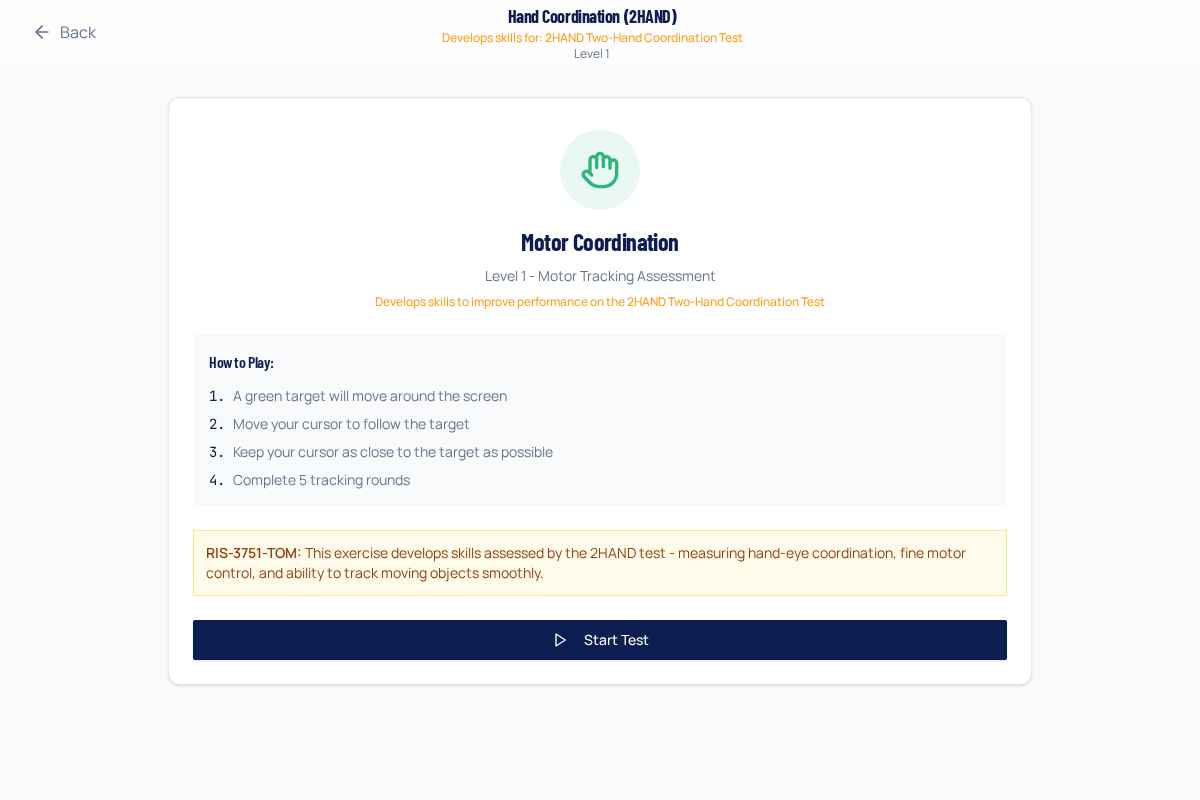
This practice develops controlled hand coordination: the ability to make accurate, appropriate and smooth movements in response to changing visual information.
Why This Matters for Train Drivers
- Train handling depends on smooth, proportionate control inputs.
- Over-correction under pressure can make performance worse.
- Drivers need stable motor control during high workload.
- Good coordination is calm, economical and controlled.
Real-World Examples
- •Making smooth traction and braking adjustments.
- •Correcting speed drift without abrupt inputs.
- •Maintaining control during low-speed movements.
- •Avoiding tense or exaggerated control movements under pressure.
RIS-3751-TOM Standard
RIS-3751-TOM links Hand coordination to the 2HAND Two Hand Coordination Test, assessing controlled movement in response to complex stimuli.
Pro Tip to Improve
Focus on smoothness and stability. Small deviations are normal; aggressive correction usually creates bigger errors.
This practice exercise develops the cognitive abilities assessed in official train driver selection, specifically:
Hand-eye coordination assessments (e.g., 2HAND-style tests)
Based on RIS-3751-TOM requirements. Learn more about official assessments →
Level 1
Premium
Level 2
Premium
Level 3
Premium
Level 4
Premium
Level 5
Premium
K.M.
J.H.
Y.E.
D.W.
B.B.