
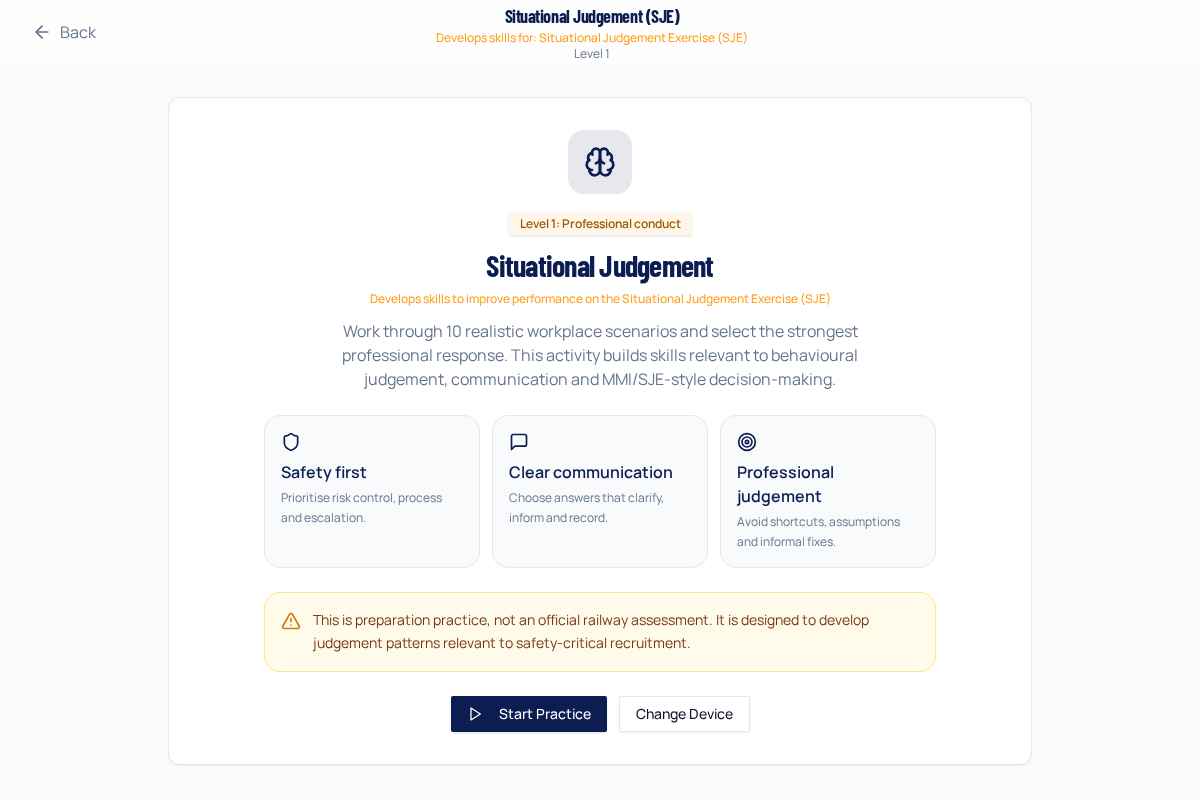
This practice develops behavioural judgement: the ability to choose safe, professional and procedurally defensible actions in realistic workplace scenarios. It is aligned to the Situational Judgement Exercise and MMI behavioural aptitude area.
Why This Matters for Train Drivers
- Train drivers work independently in safety-critical environments.
- Operators need predictable, low-risk decision-makers.
- The safest response is often procedural rather than heroic.
- Behavioural judgement is assessed alongside cognitive and psychomotor ability.
Real-World Examples
- •A colleague suggests skipping part of a process to save time.
- •A passenger reports a possible safety concern before departure.
- •You are unsure whether information is complete enough to act on.
- •You realise you may have made an operational mistake.
RIS-3751-TOM Standard
RIS-3751-TOM links behavioural aptitudes to the Situational Judgement Exercise and MMI, focusing on relevant behavioural tendencies for safe train driving.
Pro Tip to Improve
When unsure, choose the option that is safest, most procedural and most defensible. The railway usually rewards controlled judgement over bold initiative.
This practice exercise develops the cognitive abilities assessed in official train driver selection, specifically:
Situational Judgement Exercises (SJE) and structured behavioural interviews
Based on RIS-3751-TOM requirements. Learn more about official assessments →
Level 1
Premium
Level 2
Premium
Level 3
Premium
Level 4
Premium
Level 5
Premium
P.L.
C.R.
K.H.
N.J.
G.T.