
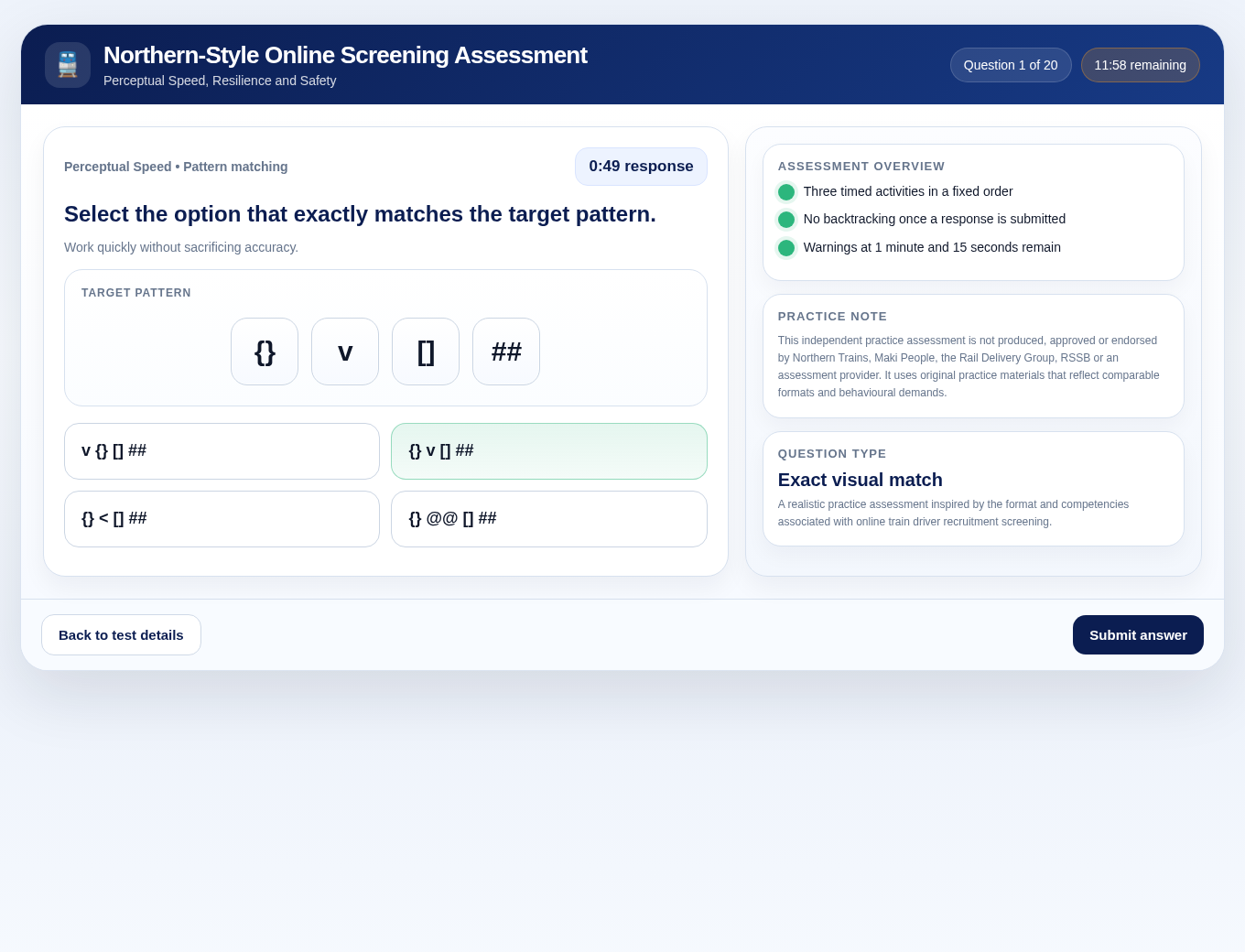
This practice combines rapid visual checking and behavioural judgement under timed conditions. It is designed to reflect comparable task formats and psychological demands commonly seen in Northern style Maki test style online screening assessments for safety-critical roles.
Why This Matters for Train Drivers
- You must sustain accurate visual discrimination while working at pace.
- Behavioural scenarios assess judgement under pressure and after setbacks.
- Safety scenarios test procedural discipline, escalation and communication.
- The blended format helps you rehearse transitions between different cognitive demands.
Real-World Examples
- •Checking similar records quickly without missing subtle differences.
- •Maintaining composure and accountability after a minor performance setback.
- •Choosing proportionate safety actions when instructions are unclear.
- •Balancing pace with accuracy when time pressure increases.
RIS-3751-TOM Standard
This is an independent practice assessment and does not claim to replicate any live employer assessment or scoring model.
Pro Tip to Improve
Practise a repeatable checking method for visual items and use a simple decision routine for behavioural items: stabilise, verify, communicate, then act within procedure.
This practice exercise develops the cognitive abilities assessed in official train driver selection, specifically:
Online screening style assessments with perceptual speed and behavioural judgement
Based on RIS-3751-TOM requirements. Learn more about official assessments →
Simulation mode (default)
- Perceptual Speed: 12 minutes
- Resilience: 8 minutes
- Safety: 8 minutes
- No in-test answer checking and no question backtracking
Practice mode
Optional untimed familiarisation with shorter sets and immediate practice guidance.
A.W.
H.
A.W.
S.R.
M.A.M.