Selective Attention (Group Bourdon)
Practice differentiating between relevant and irrelevant visual information. This exercise develops your ability to attend selectively to specific patterns while filtering out distractions.
This test develops skills needed for
Group Bourdon / TEA-Occ Selective Attention Test
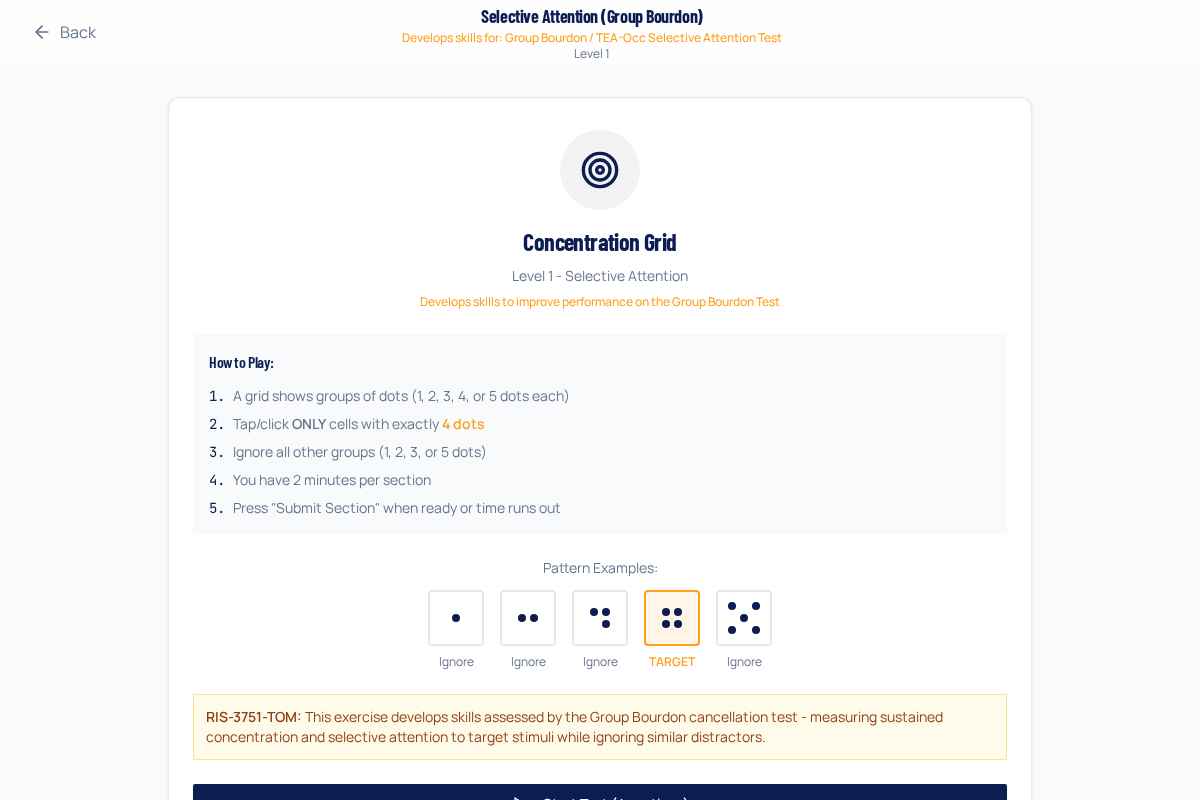
This practice develops selective attention: the ability to identify relevant visual information while ignoring similar but incorrect information. It is closely aligned to the Group Bourdon style of task, where accuracy, rhythm and consistency matter more than rushing.
Why This Matters for Train Drivers
- Train drivers must detect small but safety-critical visual cues reliably.
- The task reflects disciplined scanning rather than casual observation.
- Strong performance depends on avoiding false positives as well as missed targets.
- Consistency across the whole task is more important than a fast start.
Real-World Examples
- •Picking out the correct signal or indicator among other lineside information.
- •Maintaining visual discipline during repetitive route sections.
- •Avoiding assumptions when several cues look similar.
- •Continuing calmly after a mistake rather than rushing to recover.
RIS-3751-TOM Standard
RIS-3751-TOM places selective attention under the Attention criterion and links it to the Paper Group Bourdon and TEA-Occ assessment methods.
Pro Tip to Improve
Train rhythm and accuracy first. Do not practise as if it is a race. A slightly slower but controlled candidate is usually safer than a fast, erratic one.
This practice exercise develops the cognitive abilities assessed in official train driver selection, specifically:
Bourdon-style concentration assessments (e.g., Paper Group Bourdon)
Based on RIS-3751-TOM requirements. Learn more about official assessments →
Level 1
Premium
Level 2
Premium
Level 3
Premium
Level 4
Premium
Level 5
Premium
C.D.
M.K.
J.T.
M.V.
C.