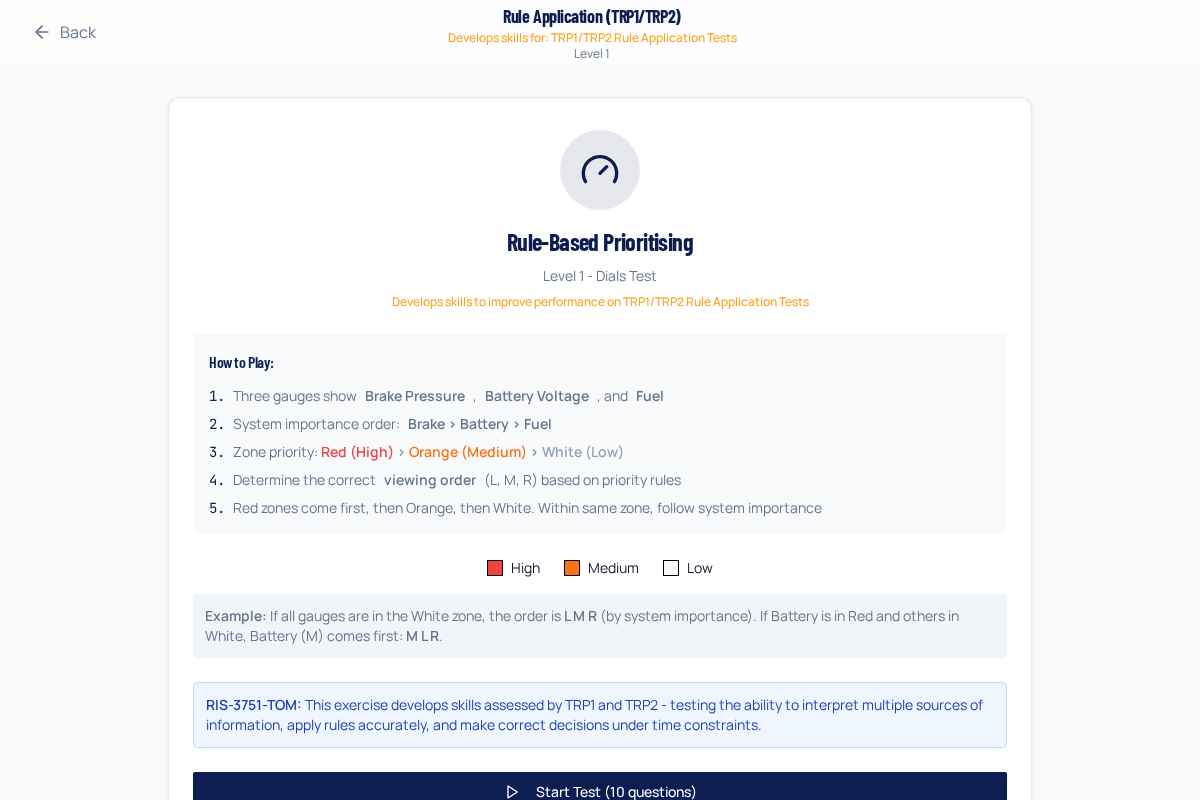
This practice develops the ability to interpret rule-based information, prioritise correctly and apply instructions consistently under time pressure. It bridges memory, reasoning and procedural decision-making.
Why This Matters for Train Drivers
- Railway decisions often involve strict priority rules.
- The safest action is not always the fastest or most convenient.
- Candidates must apply the rule given, not the rule they expect.
- Correct prioritisation prevents unsafe shortcuts.
Real-World Examples
- •Deciding which indication or instruction takes priority.
- •Applying a rule sequence during an abnormal situation.
- •Checking information in the correct order.
- •Avoiding shortcuts when under operational pressure.
RIS-3751-TOM Standard
RIS-3751-TOM identifies Memory and Reasoning as core selection criteria, assessed through TRP1 and TRP2, where candidates must learn, recall, interpret and apply information accurately.
Pro Tip to Improve
Slow down at the rule-reading stage. Most errors happen before the answer stage because the candidate has misunderstood the priority rule.
This practice exercise develops the cognitive abilities assessed in official train driver selection, specifically:
Rule-based decision making and trainability assessments
Based on RIS-3751-TOM requirements. Learn more about official assessments →
Level 1
Premium
Level 2
Premium
Level 3
Premium
Level 4
Premium
Level 5
Premium
T.G.
S.S.
L.R.
B.D.
E.A.